Chinese Paving the Road to Freedom With Cash

Embassy of the People's Republic of China in C...Image via Wikipedia
BEIJING — “They’re all millionaires. They’ve made it,” said Mikael Charette of the thousands of wealthy Chinese — his clients — who apply to emigrate to Canada every year on that country’s investment immigration program.
As part of his job, Mr. Charette, a lawyer from Montreal, scrutinizes clients’ financial records. Back in 2005, when he began working at Harvey Law Group in Beijing, he was struck by how often a family’s wealth began with the transfer of the assets of state-owned enterprises to private ownership in the 1990s. Over the course of about eight years, he estimates, those factories became fully profitable.
“Now, I look back over a decade of records, and I see that the factory is running itself. The money of the family is in the second generation, and the children are often already overseas-educated, and they, too, own real estate here,” he said.
But regardless of how wealthy they become, China’s new rich simply don’t feel secure.
“I’ve had rich businessmen say to me, ‘You can be a tiger, but there is always a hunter somewhere,”’ he said.
So they come to Mr. Charette, who specializes in investment immigration to his home province of Quebec. Or they go to other lawyers dealing in immigration to major destinations like the United States, Australia, Singapore, New Zealand and Hong Kong.
Unsolicited text messages from immigration firms have become a standard feature of life for Beijing’s upper-middle classes.
“Zero-risk emigration to America: Invest in an Idaho gold mine. For the first time in Beijing the governor himself will explain how, officially,” ran one, supplying a time and date for the meeting. “Emigrate to Australia for $200,000, 95 percent success rate, free education, generous welfare,” ran another.
In just over three decades, China has gone from being one of the poorest countries in the world to its third-biggest economy. Per capita gross domestic product in 1975 was $410. In 2009, it was $6,567, according to the World Bank.
The Hurun Rich List, based in Shanghai, says there are now 875,000 known dollar millionaires in China, an increase of 6.1 percent from a year ago.
Yet even as China grows richer, the number of its rich choosing to emigrate is rising. Many want to maintain two homes, merging their money-making abilities in China with what they perceive as the greater security and ease of international travel offered by a foreign passport or permanent residency.
Last year, for the first time, Chinese citizens became the largest group of immigrants to Australia, displacing the traditional sources of Britain and New Zealand. From July to December 2009, 13,371 Chinese became “permanent additions” (gaining or entitled to permanent residency) to Australia, overtaking Britain’s 13,037 and New Zealand’s 7,342.
While most immigrants are admitted on the basis of sought-after skills or to reunite families, investment immigration, in which applicants make a minimum financial investment or create jobs in their destination, is also booming. So much so that Canada, excluding Quebec, temporarily halted its program in June in order to double the amount that would-be immigrants must invest to qualify. Whereas before applicants required a net worth of 800,000 Canadian dollars, or about $790,000, and a 400,000-dollar investment, in the future they will need 1.6 million dollars and an investment of 800,000 dollars.
“All these changes are because we are overloaded,” Mr. Charette said. “This is a huge, sophisticated market.”
The result for Mr. Charette has been gratifying — a surge in applications to Quebec. He estimates that the window of opportunity will last until October, when Quebec, too, will adjust its policies. In February, 233 people from around Asia applied to the program, he said. In June, the month the national program closed, the number was 519. Chinese constitute up to 85 percent of applicants.
On June 26, the same day the rest of Canada temporarily closed doors, Mr. Charette addressed about 40 would-be investment immigrants in Beijing. The middle-aged men and women listened intently, most taking notes.
The looming higher rates “shouldn’t be a problem for my friends,” murmured Ms. Hou, who did not want to be identified by her full name and said she was with the People’s Liberation Army, representing rich property developers from the city of Xinxiang, in the central province of Henan.
Would she also emigrate, if she could? “Yes,” she said immediately.
Why? After all, China’s living standard is rising as the rest of the world watches the apparent success of the so-called “Beijing Model” — authoritarian politics plus fast economic growth.
Her answers mirrored those given by other would-be emigrants: Better education for the children; a pollution-free environment; better medical care; a safer food supply; bigger and cheaper housing. Added up, they are what psychologists and sociologists dub Q.O.L., or quality of life issues, factors not measured by G.D.P.
“Education is very important,” offered another woman at the seminar. “It’s different over there, and it produces different values.”
Did the current economic crisis in the West put her off?
“Not really,” she said. “They talk about it in the papers here, but I don’t know if they’re telling the truth. I trust my friends, and my friends say things aren’t that bad.”
Joy Xi emigrated to Canada nearly a decade ago. When I asked why people leave, despite rising prosperity in China, her answer was swift: “Sanlu,” the company notorious for producing melamine-laced milk powder that killed six babies and sickened hundreds of thousands more in 2008. Few believe the problem is over.
Also, said Ms. Xi, China is growing richer, but it’s also growing more unequal, and that makes the rich feel unsafe.
Summing up how many Chinese think, she cited a widespread saying: “Life in China is too risky. Consider carefully where you want to be reborn in your next life.”
Enhanced by Zemanta

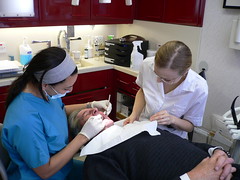
Information for foreign-trained dentists/dental surgeons

DentistImage by Wolfiewolf via Flickr

Information on requirements to practise
The practice of dentistry is regulated in Canada. In order to practise the profession or use the title of dentist or dental surgeon, you must be licensed as a member with one of the provincial/territorial regulatory bodies. These bodies set the standards for entry into the profession of dentistry and for issuing licences to those who meet the established standards of qualifications and practice. Once you know where you will settle and work, you should contact the appropriate regulatory body for information on licensing procedures (see list below).
All provincial and territorial regulatory bodies recognize the certificate of the National Dental Examining Board of Canada (NDEB). For more information on the NDEB exam and certificate, you may contact:
National Dental Examining Board of Canada (NDEB)
100 Bronson Ave, Suite 203
Ottawa ON   K1R 6G8   Canada
Phone : (613) 236-5912
Fax : (613) 236-8386
In order to write the NDEB exam, an individual must be a graduate of an accredited program in either Canada or the United States of America (USA). Currently reciprocal agreements do not exist with other countries. Graduates of dental programs outside of North America must take a two-year qualifying program.
For further general information on dental occupations in Canada, you may contact the Canadian Dental Association, "the national voice of dentistry" in Canada: 

Canadian Dental Association (CDA)
1815 Alta Vista Drive
Ottawa ON   K1G 3Y6   Canada
Phone : (613) 523-1770
Fax : (613) 523-7736
At the same address, but operating at arm's length from the CDA, the Commission on Dental Accreditation of Canada (CDAC) defines acceptable national standards for educational institutions in the field, and cooperates with provincial/territorial regulatory bodies, the NDEB, and other organizations to develop the accreditation process. For more information on the CDAC and accreditation in Canada, contact the Commission:
Commission on Dental Accreditation of Canada (CDAC)
1815 Alta Vista Drive
Ottawa ON   K1G 3Y6   Canada
Phone : (613) 523-7114
Phone (alternate): 1-866-521-2322
Those who wish to work in a dental specialty should also consult the dental regulatory body in the jurisdiction where they want to practise (see list below), because many jurisdictions require licensure for specialties through the Royal College of Dentists of Canada (RCDC). The RCDC offers specialist examinations in: dental public health, dental sciences, endodontics, oral and maxillofacial surgery, oral medicine and oral pathology, oral and maxillofacial radiology, orthodontics, pediatric dentistry, periodontics, and prosthodontics. Successful completion of one of these specialty examinations may lead to a Fellowship in the College and the designation FRCD(C).
To write the National Dental Speciality Examination administered by the Royal College of Dentists of Canada (RCDC), one may be required to be a graduate of an accredited program. Contact the RCDC for more information:
 

Royal College of Dentists of Canada (RCDC)
180 Dundas Street West, Suite 2003
Toronto ON   M5G 1Z8   Canada
Phone : (416) 512-6571
Fax : (416) 512-6468
Information on assessment of qualifications
Foreign-trained dentists, regardless of education, licensure, or experience, must obtain a Canadian licence to practise dentistry in Canada. Those who wish to obtain further information about qualifying programs and the Eligibility Examination for enrolling in them should contact the Association of Canadian Faculties of Dentistry (ACFD):
Association of Canadian Faculties of Dentistry (ACFD)
100 Bronson Avenue, Suite 204
Ottawa ON   K1R 6G8   Canada
Phone : (613) 237-6505
Fax : (613) 236-8386
If you plan to work in Quebec, you should contact l'Ordre des dentistes du Québec, and in Alberta, you should contact the Alberta Dental Association and College. Please note that the review of your credentials determines only your eligibility to write a certification exam; it does not guarantee recognition of your credentials for the purpose of employment or licensure in Canada.
You may also consult our Fact Sheet No. 2, "Assessment and recognition of credentials for the purpose of employment in Canada," for further general information.
Other relevant information

University of Toronto, faculty of Dentistry.

International Dentist Advanced Placement Program for Foreign-Trained Dentists

The International Dentist Advanced Placement Program (IDAPP ) is a special university program held over five months. After successful completion of this program students are fully integrated into the third year of our four year Doctor of Dental Surgery Program (DDS), leading to the degree of Doctor of Dental Surgery. The program is intended for graduates of non-accredited dental programs, i.e. educational programs that have not been recognized by the Commission on Dental Accreditation of Canada (CDAC) or the American Dental Association Commission on Dental Accreditation. Its purpose is to prepare students to take the examinations of the National Dental Examining Board of Canada (NDEB), the same examinations which graduates of accredited dental programs must take to obtain certification. Upon successful completion of the International Dentist Advanced Placement Program and the NDEB examinations, the candidate will be eligible for licensure/registration as a Dentist in all provinces in Canada .
 

Enhanced by Zemanta

Leave us a message

Check our online courses now

Check our online courses now
Click Here now!!!!

Subscribe to our newsletter

Vcita